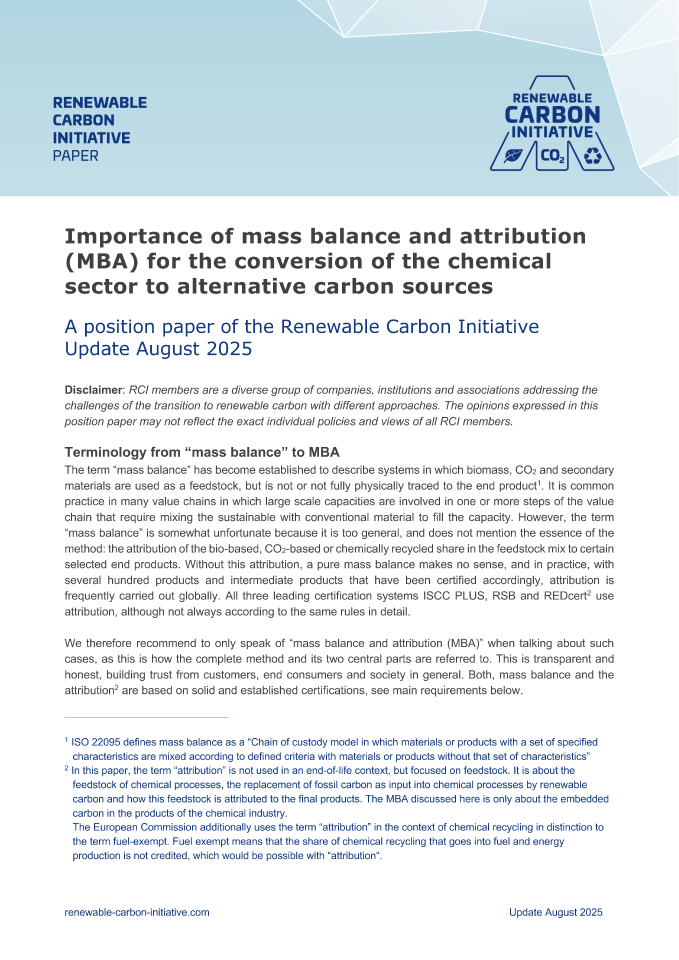
Importance of Mass Balance and Attribution (MBA) for the Conversion of the Chemical Sector to Alternative Carbon Sources: Update 2025 – RCI Position Paper (August 2025)
FREE
This position paper highlights the importance of mass balance and attribution “MBA” as one possible way to incentivise the transformation of the chemical sector away from fossil and on towards renewable carbon.
The term “mass balance” has become established to describe systems in which biomass, CO2 and secondary materials are used as a feedstock, but is not or not fully physically traced to the end product. Using the MBA approach makes it possible to substitute large quantities of fossil raw materials and attractive renewable content shares can be attributed to desired materials or products for which demand on the market exists. Through this, chemistry can stepwise, but continuously, increase the shares of renewable carbon
However, the term “mass balance” is somewhat unfortunate because it is too general, and does not mention the essence of the method: the free attribution of the bio-based, CO2-based or chemically recycled share in the feedstock mix to certain selected end products. Without this attribution, a pure mass balance makes no sense, and in practice, with several hundred products and intermediate products that have been certified accordingly, attribution is frequently carried out globally. The RCI recommends to only speak of “mass balance and attribution (MBA)” as this is transparent and honest, building trust from customers, end consumers and society in general. Both, mass balance and the free attribution are based on solid and established certifications.
Besides terminology, there is still a need for regulatory harmonisation between the schemes of the existing certification systems. MBA cannot only be applied for bio-based feedstock, but also for CO/CO2 or feedstock from chemical recycling, both will gain strongly in importance in the coming years. Every MBA scheme should cover these three renewable feedstocks: biomass, CO/CO2 and recycling.
This 2025 update now includes a brief overview and figure of MBA as defined at EU level, via the SUPD Implementing Decision on the recycling of a single-use plastics bottle- This establishes overall regulatory support for MBA in the EU as well as an applicable methodological framework for MBA in practice.

-
-
Policy Proposals for Facilitating the Transition to Renewable Carbon – RCI Report (April 2025)
Markets & Economy, Policy, Sustainability & Health, Technology
70 Pages
1488 Downloads
-
Evaluation of Recent Reports on the Future of a Net-Zero Chemical Industry in 2050 – RCI Report (November 2024)
Markets & Economy, Policy, Sustainability & Health
20 Pages
2055 Downloads -
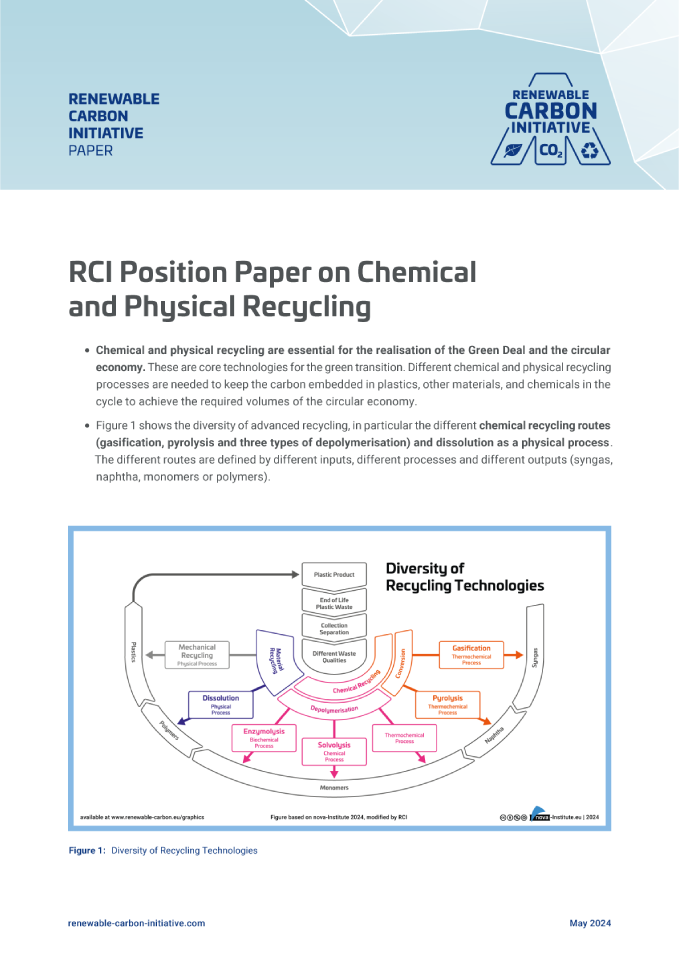
Chemical and Physical Recycling – RCI Position Paper (May 2024)
Policy, Technology
4 Pages
1014 Downloads
Related Products
-
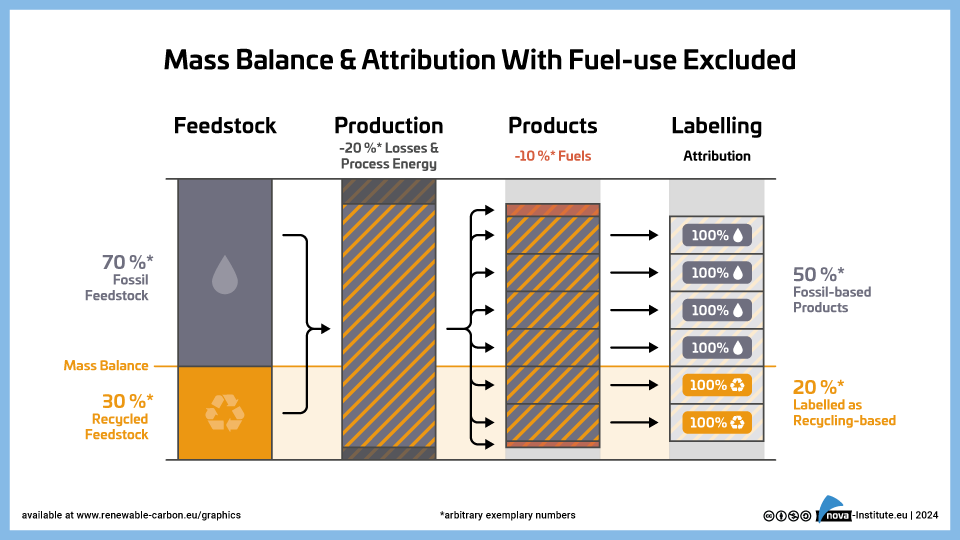
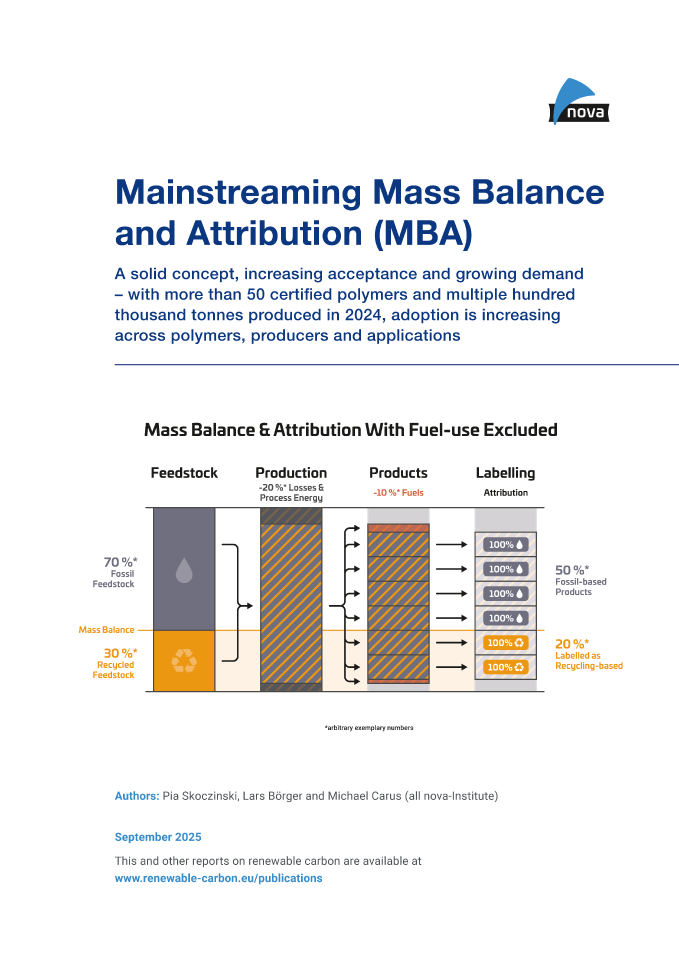
Mass Balance & Attribution With Fuel-use Excluded (PNG)
Markets & Economy, Policy, Sustainability & Health, Technology
1 Page
313 Downloads